
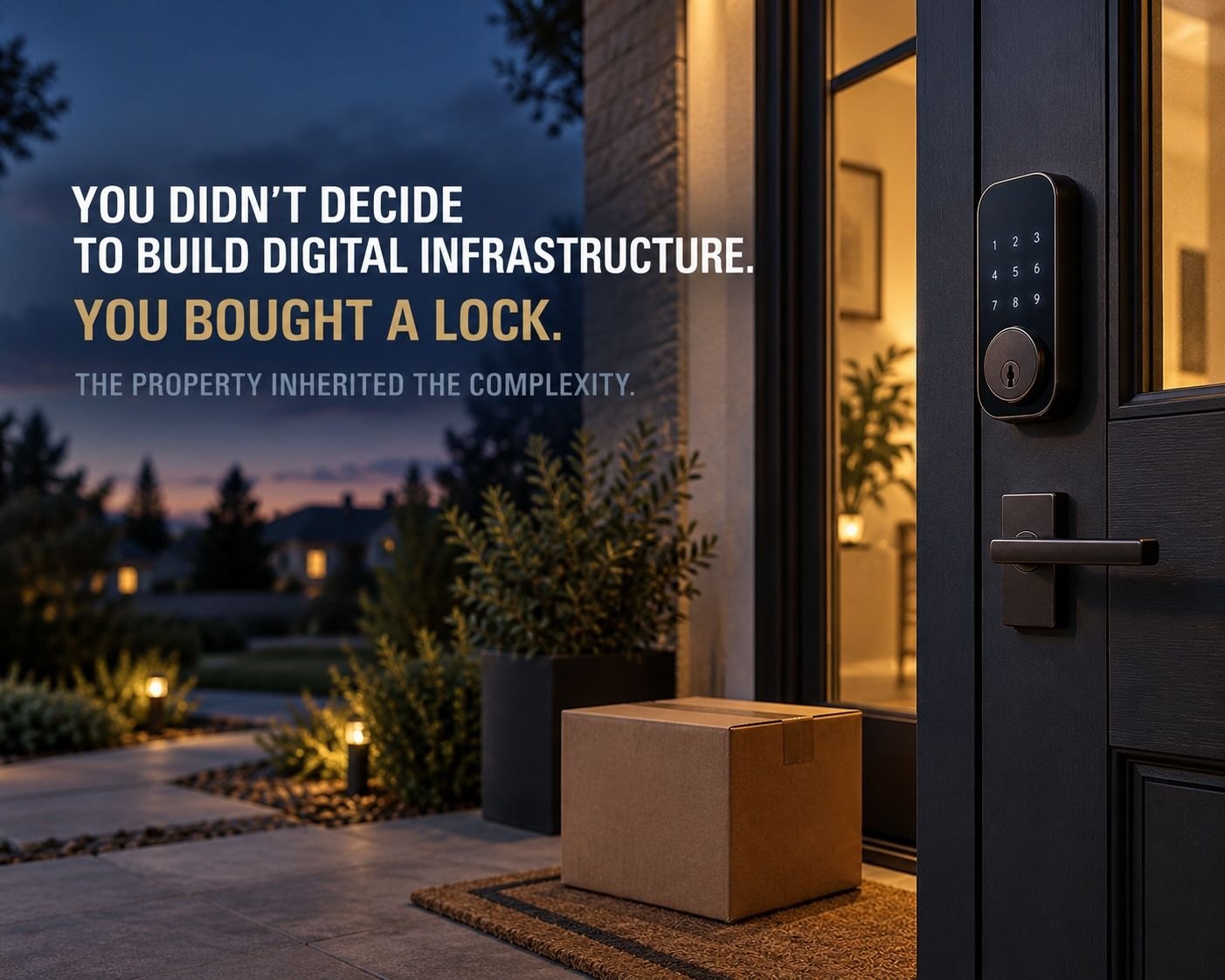
The property inherits the complexity.
I keep coming back to a contradiction in consumer behavior.
Someone will say the Internet of Things sounds too technical, too complicated or simply not worth thinking about.
Then they see an August smart lock on sale on Amazon. They click “Buy Now.”
They install the lock, download the app, create an account, connect it to Wi-Fi and perhaps link it to Alexa or Apple Home.
Just like that, they’re part of the IoT conversation, whether they realize it or not.
They didn’t decide to create digital infrastructure.
They bought a lock.
That distinction matters because, years later, they may sell the house. The hardware stays attached to the door, but its account, permissions, integrations and access may exist somewhere else.
Now the question is neither technical nor theoretical:
Who controls the lock after closing, and what proves it?
The lock is one device. The average home has 21 or more.
The average U.S. home already has 21+ connected devices, and every holiday season adds more. Every device has an account, and every account starts a conversation the owner thinks ended at installation. It didn’t. It’s still open the day the house sells.
Twelve states’ purchase contracts already name those devices at the sale. Not one of them says who checks that the handoff happened.
Buy it. Install it. Connect it. Forget it.
I don’t blame the homeowner.
The entire market was designed to make connected technology effortless to purchase and nearly invisible once installed:
Buy it. Install it. Connect it. Forget it.
But the property eventually inherits all of that forgotten complexity.
The market made connected devices easy to buy. It never made connected properties easy to transfer.
That is no longer just a smart-home problem. It is a real-estate infrastructure problem.
What a clean handoff looks like
At the listing appointment, the agent’s phone finds what’s connected in the house. The seller reviews the list, edits it and signs before closing. The signed SL8 Report™ lives on the home’s MyHOME ID™, so the record stays with the house, not the owner.
Every Home Is Smart, It Just Doesn't Know It Yet.™
CleanSL8® provides seller-authorized, point-in-time workflows for identifying, reviewing, and documenting Smart Device Fixtures™ during a real estate transaction. MyHOME ID™ provides the persistent property identity and continuity layer through which those records can endure beyond a single ownership event.
Source for 21+ devices: Deloitte, Connected Consumer Study, 4th edition (2023).