
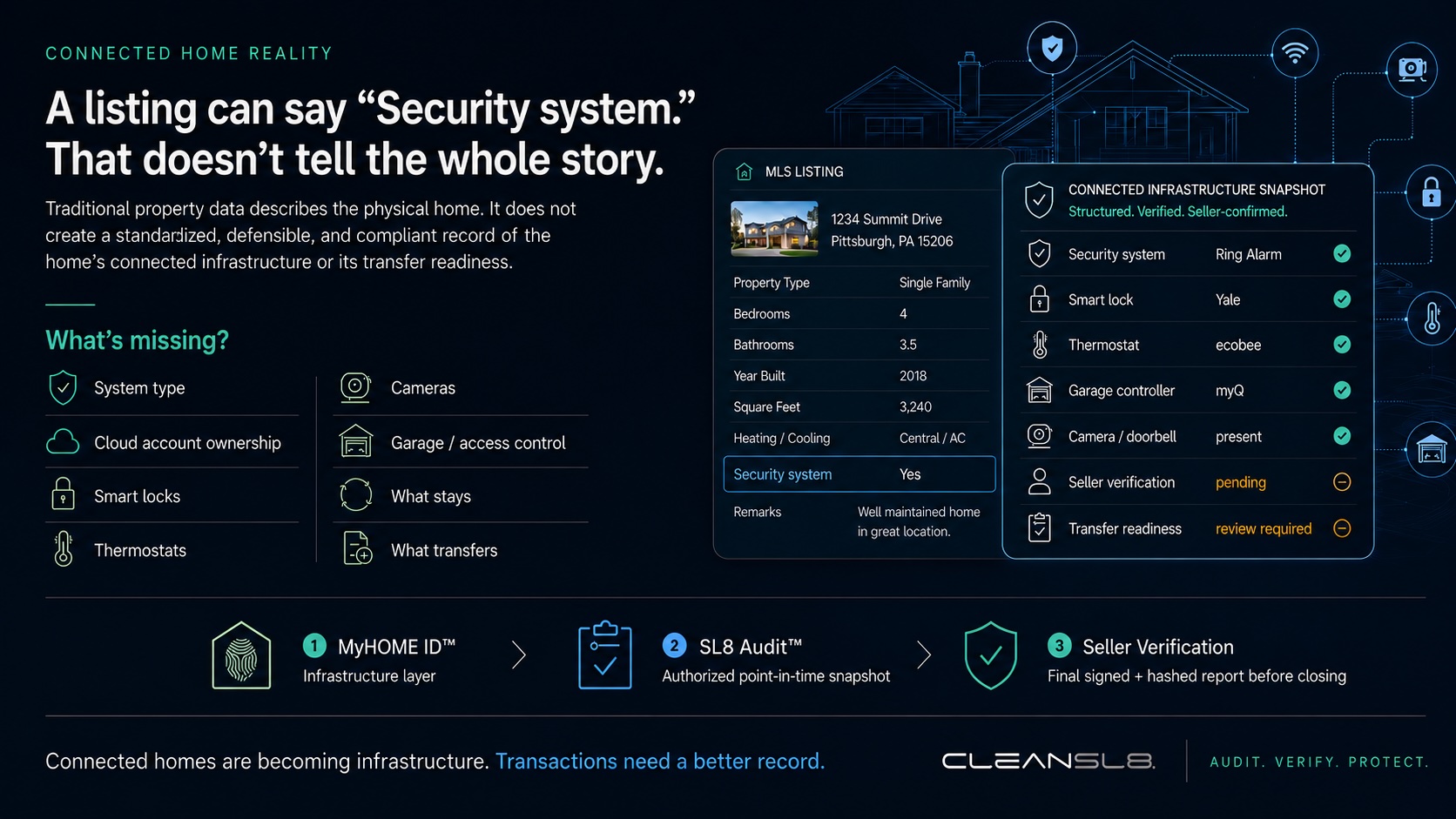
The traditional property record can describe nearly every physical feature of a home. The connected systems operating inside it remain largely invisible.
A real estate listing can tell us an extraordinary amount about a property.
It can identify the architectural style, year built, square footage, number of bedrooms and bathrooms, heating and cooling systems, taxes, flood data, school district, public-record history, appliances, interior finishes, and hundreds of other details.
Then, buried among those fields, two words may appear:
Security system.
At first glance, that seems useful. The home has a security system. The box has been checked.
But what does that field actually tell the seller, buyer, agents, inspectors, title professionals, or closing team?
Very little.
“Security system” could refer to an older DSC alarm panel installed decades ago. It could mean Ring Alarm, SimpliSafe, Alarm.com, Honeywell, Resideo, Vivint, ADT, Control4, or a custom system assembled by a local installer.
Those systems are not interchangeable.
They may involve different hardware, cloud services, subscriptions, mobile applications, professional monitoring agreements, installer relationships, account credentials, transfer procedures, and ownership restrictions. Some may continue functioning after a home changes hands. Others may remain physically installed while becoming inaccessible to the buyer.
The listing tells us that something exists.
It does not tell us what exists, who controls it, whether it will remain, or what must happen before the buyer can use it.
That is no longer a minor omission.
It is a missing layer in the residential transaction.
The physical home is documented. The connected home is not.
The real estate industry has built a sophisticated data ecosystem around the physical property.
A single address may be connected to:
- MLS records
- County tax data
- Flood information
- Valuation models
- Permit history
- Public records
- Property reports
- Listing photographs
- Appliance and fixture disclosures
- Inspection findings
- Title and settlement records
These systems help participants understand what the property is, what it contains, what it may be worth, and what risks may affect the transaction.
But homes have quietly evolved beyond their physical components.
A modern property may also contain smart locks, thermostats, video doorbells, cameras, garage controllers, lighting systems, alarm panels, hubs, sensors, leak detectors, irrigation controllers, energy-management systems, and integrations with Alexa, Google Home, Apple Home, or manufacturer-specific platforms.
Many of these systems are physically attached to the property. Many tend to stay with the property. Yet the accounts, permissions, subscriptions, credentials, and administrative control associated with them may remain connected to the seller.
That creates a growing divide between what the property record says and what actually operates inside the home.
A listing may say:
Security system: Yes.
But the transaction still needs to answer:
- What system is installed?
- Which components are present?
- Which components are connected?
- Which items are intended to remain?
- Which items will the seller remove?
- Is the equipment owned, financed, rented, or tied to a service agreement?
- Is professional monitoring active?
- Is an installer or third party involved?
- What cloud account is associated with the system?
- What must the seller address before closing?
- What will the buyer need to activate or establish after closing?
Without a structured workflow, those questions are often handled through scattered conversations, informal notes, generic disclosure language, or last-minute troubleshooting.
Sometimes they are not addressed at all.
A fixture can remain while access does not transfer
Connected systems create a distinction that traditional property records were not designed to capture.
The hardware may remain in the home while the buyer receives no practical ability to use it.
A smart thermostat can still be mounted on the wall but remain associated with the seller’s account. A video doorbell can be physically included in the sale while still registered to a previous owner. A garage controller may remain installed but require an account reset, invitation, or manufacturer-specific transfer process.
The same issue can affect alarm systems, locks, cameras, lighting platforms, hubs, and other Smart Device Fixtures™.
This does not automatically mean that a seller intentionally retained access. It means the transaction may contain no standardized evidence showing what was observed, what was represented, what the seller confirmed, or what steps were completed.
In digital systems, physical possession and administrative control are not the same thing.
Handing over the keys does not necessarily hand over the connected home.
The answer is not continuous surveillance
Documenting connected infrastructure does not require monitoring a seller’s home.
It does not require controlling installed systems, reading private communications, collecting personal content, or maintaining indefinite access to the seller’s network.
The appropriate model is a seller-authorized, point-in-time workflow.
That distinction is central to the way CleanSL8® approaches the transaction.
With the seller’s express permission, a SL8 Audit™ identifies Smart Device Fixtures observable through the seller’s network at that specific moment. The process is limited to the authorized connected environment and does not claim to discover every physical device that may exist elsewhere in the home.
It is a snapshot, not a permanent assertion.
A seller may later add a device, remove one, replace equipment, disconnect a system, relocate a component, or change the network. A device that was present during an earlier snapshot may not remain connected when the transaction reaches closing.
For that reason, the workflow must account for change rather than pretending the connected environment is static.
Two seller-confirmed gates
The CleanSL8 workflow uses two distinct seller-confirmed gates.
Gate One: Authorization
The seller expressly authorizes connection to the network for the limited purpose of creating the snapshot.
This establishes a clear boundary around the observation. CleanSL8 does not simply enter a connected environment and begin collecting information. The process starts with permission.
Gate Two: Review and verification
After the snapshot is created, the seller reviews what was captured.
The seller can confirm what stays, what goes, what has changed, and whether anything relevant may have been missed. This step matters because network observation alone cannot determine every contractual or transactional fact.
A connected device may be visible, but the seller still needs to confirm whether it is included in the sale.
A system may be physically installed but scheduled for removal.
An item may have been disconnected during the snapshot.
A device may belong to a third-party service provider.
Technology can help organize the evidence. The seller must verify the transaction-specific meaning of that evidence.
Why a final snapshot matters
An early snapshot can help the seller and listing agent understand the property’s connected environment before questions begin accumulating.
But the connected home may change during the listing period.
For that reason, CleanSL8 highly recommends a final snapshot shortly before closing.
The updated record gives the seller an opportunity to review the current environment and confirm:
- Which Smart Device Fixtures remain
- Which items were removed or replaced
- Which devices were disconnected
- Which observations require clarification
- Whether anything relevant was missed
- What the buyer should expect at possession
- What still requires attention before settlement
The seller digitally signs the final record, and the report is cryptographically hashed.
The result is a verifiable, point-in-time record that can be delivered to the closing table.
It does not promise that the connected environment will never change again. It establishes what was observed and seller-confirmed at a defined moment in the transaction.
That is a much stronger foundation than a generic checkbox.
How MyHOME ID, the SL8 Audit, and SL8 Sentinel work together
The connected property needs more than a one-time device list. It needs identity, structure, and continuity.
MyHOME ID™: the infrastructure layer
MyHOME ID provides a persistent identity for the property.
Traditional records may exist across separate MLS systems, public databases, inspection platforms, vendor accounts, and transaction files. MyHOME ID creates the property-associated infrastructure layer through which connected-home records can maintain continuity over time.
The identity remains associated with the property even as owners, occupants, service providers, technologies, and individual devices change.
SL8 Audit™: the authorized observation
The SL8 Audit creates an authorized, point-in-time snapshot of Smart Device Fixtures observable through the seller’s network.
It does not continuously monitor the home. It does not control the connected systems. It does not assume the snapshot will remain permanently accurate.
It records what was observable within the authorized scope at that moment.
SL8 Sentinel™: the structured record
SL8 Sentinel organizes those authorized observations into a consistent transaction record.
Instead of leaving connected-home information scattered across photographs, emails, handwritten notes, mobile applications, and verbal representations, the information can be structured around the property and prepared for seller review.
Together, these components create a workflow that is:
Property-associated. Authorized. Time-bound. Seller-reviewed. Verifiable.
This is infrastructure, not another listing feature
The industry does not need one more free-text field asking an agent to describe the smart home.
Agents should not be expected to become security technicians, network engineers, cloud-account specialists, or manufacturer support representatives.
The missing piece is infrastructure.
The listing system should be able to recognize that a connected-property record exists, just as it recognizes links to tax data, flood information, valuations, disclosures, or other property reports.
The detailed workflow can then take place through a system designed specifically for Smart Device Fixture continuity and transaction readiness.
That creates a clearer division of responsibility:
The MLS identifies that connected infrastructure is present.
The seller authorizes the snapshot.
The SL8 Audit records observable Smart Device Fixtures.
SL8 Sentinel structures the observations.
The seller reviews and verifies the record.
The final report is signed, hashed, and prepared for the transaction.
No single checkbox can accomplish that.
“Security system” should be the beginning of the next layer
The phrase “security system” is not wrong.
It is simply incomplete.
It tells us that the physical property may contain connected infrastructure. It does not create a standardized, defensible, and compliant record of what that infrastructure includes or how it should be addressed during the transaction.
As connected systems become more deeply embedded in homes, the gap will become harder to ignore.
The traditional property record describes the physical home.
MyHOME ID establishes identity and continuity for the connected home.
The SL8 Audit and SL8 Sentinel provide an authorized, seller-verified snapshot of its observed connected infrastructure at a specific moment in the transaction.
“Security system” should not be the beginning and end of the record.
It should be the beginning of the next layer.
Your Home Is Smart, It Just Doesn’t Know It Yet.™