
For years, the industry has treated smart home documentation as a point-in-time exercise.
Create a list.
Document the devices.
Transfer the property.
Move on.
The problem is that connected infrastructure doesn't operate in a point-in-time environment.
It operates inside a constantly changing ecosystem.
Transfer requirements change.
Vendors modify workflows.
Apps evolve.
Cloud services add new ownership restrictions.
Dealer-only systems introduce new dependencies.
The inventory may stay the same.
The transfer reality may not.
The Discovery
When we began documenting Smart Device Fixtures (SDFs), we assumed the challenge was identifying what existed.
Over time, we discovered a different problem.
Understanding what exists is only half the equation.
Understanding what is required to transfer it may be more important.
A home documented six months ago may contain the exact same devices today.
Yet the transfer requirements associated with those devices may have changed entirely.
>>> REAL WORLD SCAN/REPORT - Pittsburgh Condo
Examples
A vendor may:
- Introduce new account-release requirements
- Change ownership transfer procedures
- Restrict transfers to authorized dealers
- Modify mobile app onboarding
- Deprecate legacy workflows
- Create new dependencies between cloud accounts and physical devices
None of these changes alter the physical home.
All of them can affect continuity after closing.
The Emerging Gap
The residential transaction process is built around documenting static conditions.
Connected infrastructure introduces dynamic conditions.
That creates a gap.
The home remains unchanged.
The ecosystem surrounding the home does not.
Why Transition Intelligence Exists
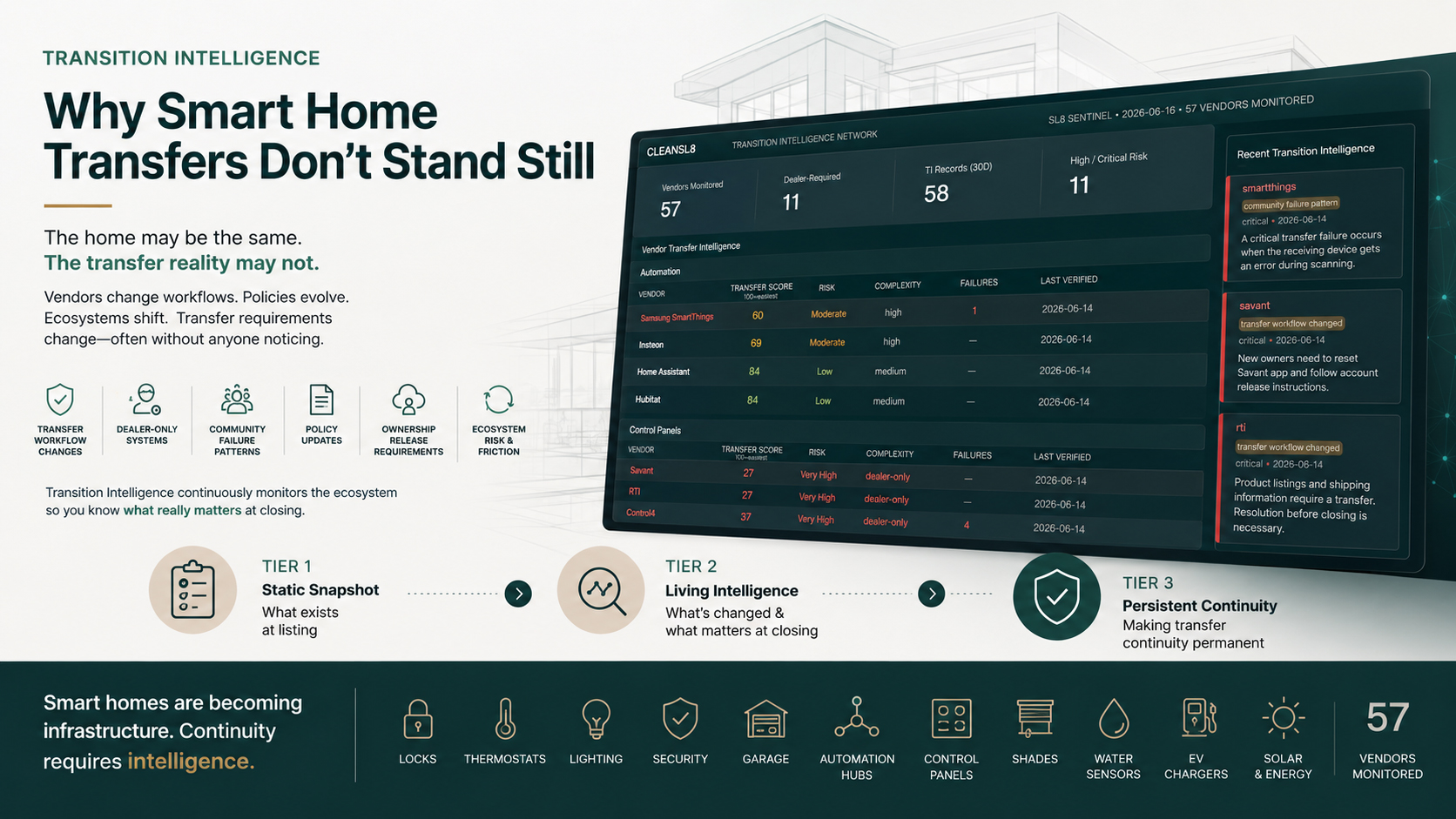
This realization led us to build what we call Transition Intelligence.
Rather than viewing transfer readiness as a single event, we view it as an evolving information problem.
Transition Intelligence continuously tracks:
- Transfer workflow changes
- Dealer-required systems
- Community-reported failures
- Vendor policy updates
- Ownership release requirements
- Ecosystem risks that may affect continuity
The goal is not to predict every problem.
The goal is to identify meaningful changes before they become someone else's problem.
Looking Ahead
Homes have quietly evolved into connected infrastructure.
The next challenge is not simply documenting what is installed.
It is understanding how the ecosystem surrounding that infrastructure changes over time.
Because continuity isn't created by documentation alone.
It requires awareness of the systems that continue evolving long after the devices are installed.
Your Home Is Smart, It Just Doesn’t Know It Yet.