
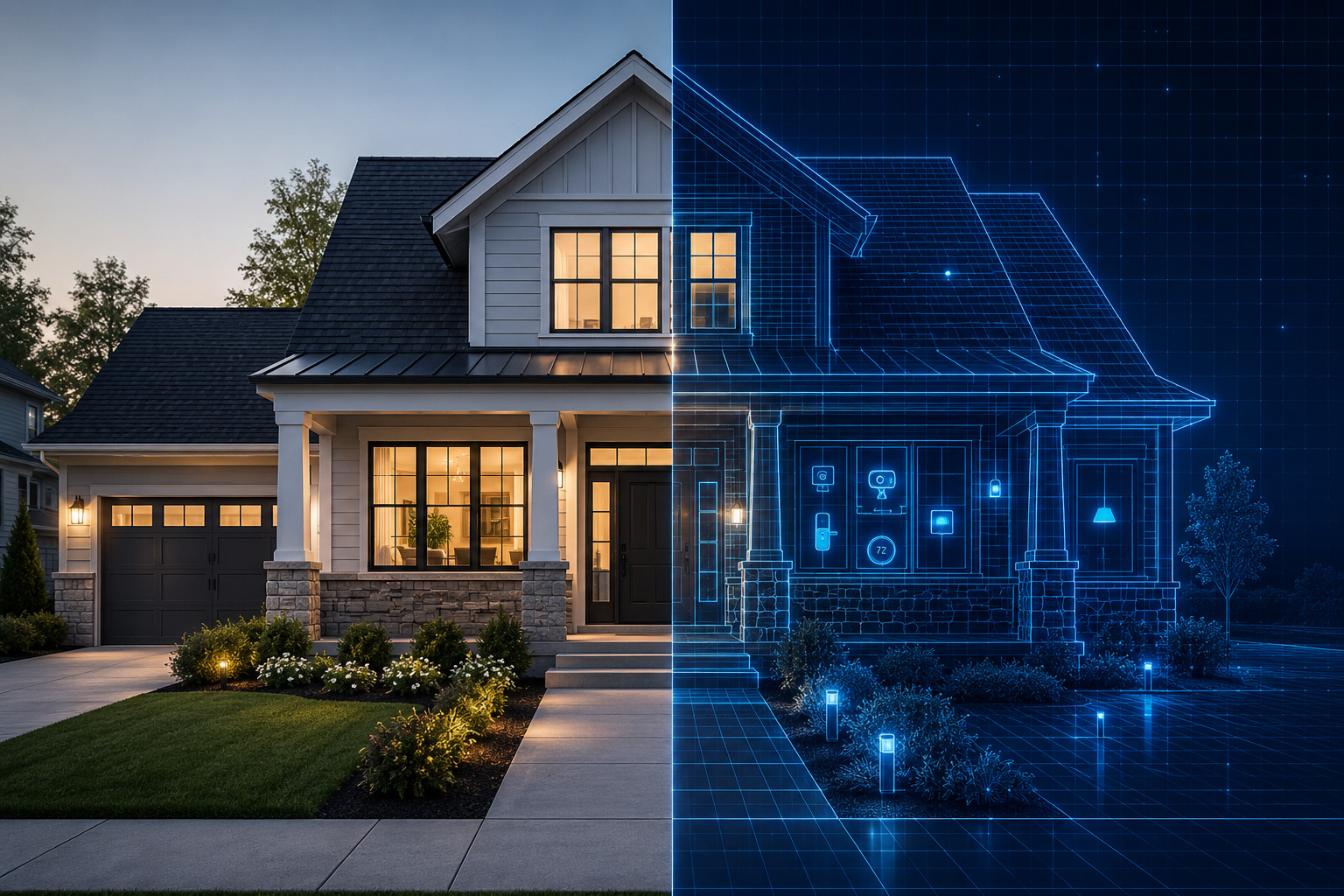
Every home already has an identity. It just hasn’t been formalized.
That’s the gap MyHOME ID is designed to close—not by adding another feature to the transaction, but by establishing a foundational layer the transaction has always been missing.
Before anything else, it’s important to understand the scope.
MyHOME ID is not being rolled out one property at a time.
We have already instantiated identity records for over 135 million U.S. homes—creating a deterministic foundation that exists independent of user participation, transactions, or platform adoption.
This is not a future state.
It’s a pre-established layer.
From here, the system expands in two directions:
- Coverage — continuing to ingest and normalize new addresses, edge cases, and international inventory over time
- Depth — enriching each MyHOME ID with structured metadata as transactions occur and Smart Device Fixtures (SDFs) are documented
In other words, every home already has a place in the system.
Engagement simply determines how much of that identity is expressed.
Think of it this way:
MyHOME ID functions like a VIN for the home.
From there, everything else falls into place:
- Parcel (APN) is the license plate + DMV record
It tells you where the property sits and how the county tracks and taxes it.
It can change with subdivision, reassessment, or jurisdictional updates. - A listing (MLS) is more like a Carfax or dealer listing
It’s temporary, marketing-driven, and exists only during a transaction.
The distinction is simple—but critical:
- MyHOME ID (VIN) = permanent identity layer (what the home is)
- Parcel/APN = government tracking layer (where it is)
- MLS listing = transaction layer (when it’s for sale)
Most systems in real estate reset every time a home is sold.
MyHOME ID is the layer that doesn’t.
The Problem Isn’t Devices—It’s Continuity
Smart homes didn’t break real estate. They exposed a gap that was already there.
Homes are now filled with Smart Device Fixtures (SDFs)—locks, thermostats, lighting systems, hubs—each tied to accounts, permissions, and networks. But when a property changes hands, there is still no consistent, verifiable way to:
- Transition access responsibly
- Document what actually stays with the home
- Confirm what has been reset or transferred
- Provide buyers with a clear view of what they’re inheriting
That gap isn’t just operational—it’s a cybersecurity and privacy risk.
And it compounds over time.
Every incomplete transition introduces uncertainty. Every undocumented system increases friction. Every missed handoff carries forward into the next owner.
MyHOME ID: Establishing Continuity
MyHOME ID creates a persistent, deterministic identity for each property—regardless of whether someone actively engages with it.
It is not a user account.
It is not a profile.
It does not depend on participation.
It simply exists as the anchor point for the home.
From that anchor, continuity becomes possible:
- Smart Device Fixture documentation and classification
- Verified transfer events across transactions
- Metadata tied to the home’s digital environment
- A stable reference point for future integrations
As outlined in our internal system design, this isn’t about incremental improvement—it’s about defining the layer the system runs on.
Depth: What Actually Lives Inside a MyHOME ID
At its core, MyHOME ID captures metadata, not devices.
Devices change.
Accounts reset.
Manufacturers evolve or disappear.
Metadata persists.
Within a MyHOME ID, we structure:
- Verified SDF categories (climate, access, lighting, infrastructure, etc.)
- Device-level attributes and fingerprints (where appropriate)
- Transfer confirmations and state changes
- Context tied to the property—not the individual owner
This creates a record that is:
- Point-in-time
- Non-invasive
- Structured for clarity, not surveillance
It’s not about monitoring a home.
It’s about making the home understandable at the moments that matter.
Breadth: Where This Expands
Once identity is established, everything else becomes easier—because other systems now have something stable to connect to.
MyHOME ID naturally extends into adjacent layers:
Real Estate Transactions
- Standardized SDF handoffs
- Reduced ambiguity between buyer and seller
- Verifiable transition records
Title & Lending
- Clearer visibility into property-level infrastructure
- Potential signals tied to system completeness
- Cleaner disclosures
Insurance & Risk
- More accurate understanding of installed systems
- Better alignment between risk and reality
Service Ecosystem
- Structured onboarding for installers and integrators
- Reduced friction for new homeowners managing inherited systems
At this point, MyHOME ID stops looking like a product—and starts functioning as shared infrastructure.
Why This Hasn’t Existed Before
Because the industry has been optimized around transactions, not continuity.
Everything resets at closing:
- New accounts
- New assumptions
- New gaps
But the home doesn’t reset.
Its systems persist.
Its dependencies persist.
Its risks persist.
MyHOME ID acknowledges that reality—and builds accordingly.
Where KODA Fits
At the coordination layer sits KODA (Keeper of Digital Assets).
KODA is not the product. It governs how this identity system scales and interacts across participants.
It operates in two ways:
As a Digital Asset
KODA exists as a transferable digital asset, with optional participation for those engaged in secondary markets.
As a Utility Layer
More importantly, it functions as a unit of coordination within the ecosystem:
- Enabling interactions between services
- Supporting integrations with real estate-adjacent providers
- Acting as a consumption layer—similar to how cloud platforms abstract compute into usable units
Over time, this allows MyHOME ID to connect not just data—but activity.
The Bigger Picture
We didn’t start with KODA.
We started at the most grounded point: the transaction.
Agent-initiated documentation.
Real homes.
Real transfers.
Real friction.
Because that’s where a system like this can take hold.
Over time, the dependency on manual input decreases.
The identity persists.
The record compounds.
The ecosystem builds around it.
Final Thought
Homes are becoming more connected, more complex, and more dependent on digital infrastructure.
But the systems around them haven’t kept pace.
MyHOME ID doesn’t add complexity.
It organizes what already exists—and makes it usable, transferable, and eventually, standard.
That’s the shift.
Your Home Is Smart, It Just Doesn’t Know It Yet.