
The Ghost Device Problem Has a New Dimension How AI-assisted threats are shaping the case for verified property infrastructure
Smart home devices create a documentation problem at every property transaction. That problem is well-established. What is less discussed is that the same architectural gap — no verified record of what devices are in a home, who has credential access, and whether transfer occurred — also creates a security exposure.
A recent piece in How-To Geek made the observation plainly: AI tools have lowered the barrier to entry for exploiting smart home vulnerabilities. The technical knowledge previously required to probe a connected device ecosystem is no longer the constraint. The constraint is now intent.
The documentation gap that creates friction in transactions also creates exposure in occupancy. These are the same gap.
This is not a tangential observation. It is the same infrastructure problem CleanSL8 was built to address — stated from a different angle.
The Attack Surface Is the Undocumented Fixture Layer
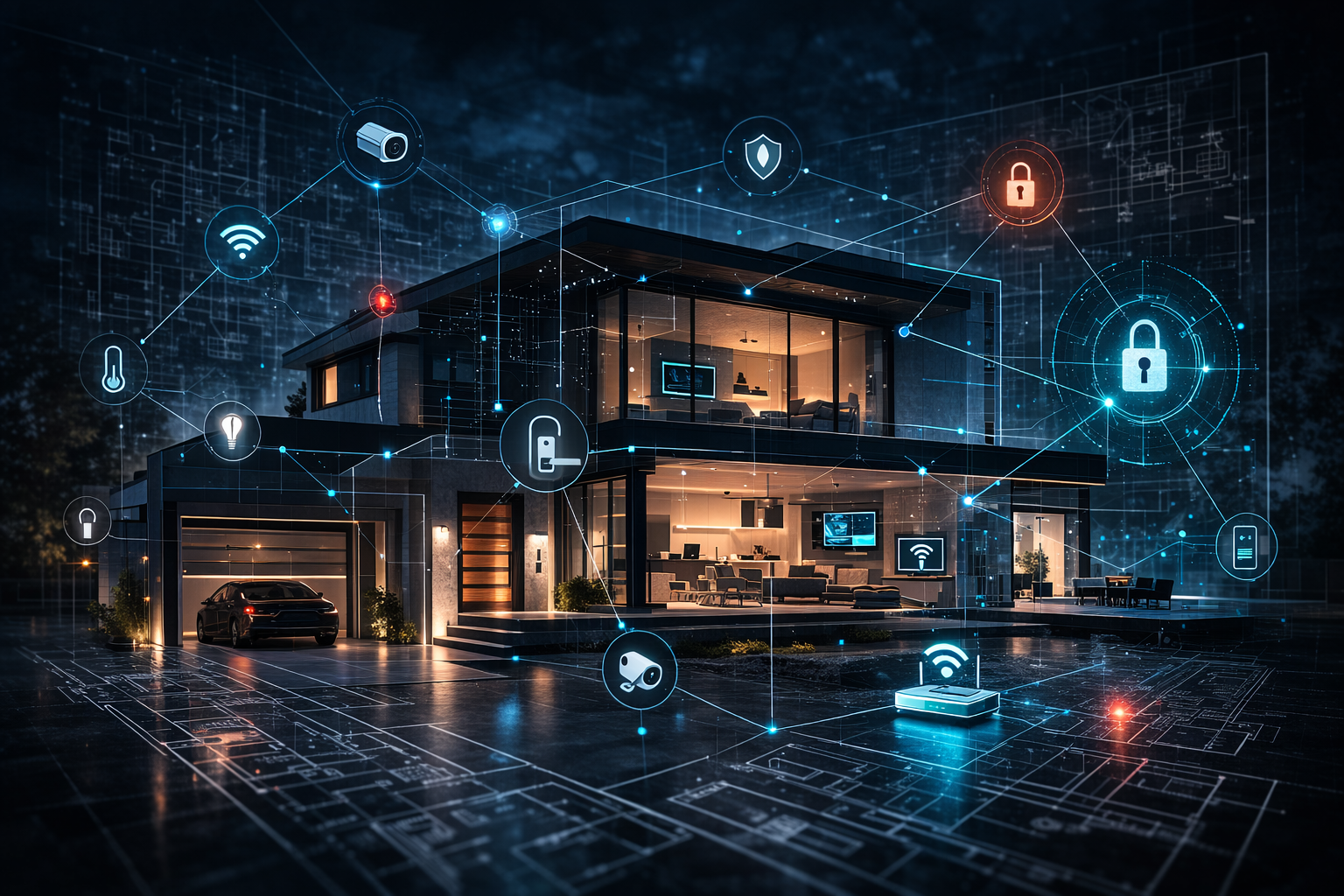
Modern residential properties contain 15 to 20 connected devices on average. Smart locks. Thermostats. Security cameras. HVAC controllers. Video doorbells. Each is a node on a network. Each represents a potential access point.
None of these devices appears in a title report. None is captured in MLS documentation. None has a standardized transfer protocol in a residential transaction. The industry does not have a field for them.
That undocumented layer is precisely what an attacker would probe. Not because documentation would stop every attack — but because the absence of documentation means no one has mapped what exists, what has access, or whether prior credentials were properly revoked.
A device that was never documented at purchase was never documented at transfer. If the previous owner's credentials were not revoked, the access still exists. The How-To Geek article describes this vector plainly: once a device is compromised or accessed, the exposure extends to the full network. Every device on the same network becomes reachable.
Ghost Devices Are Not Just a Transaction Problem
We coined the term Ghost Device to describe connected fixtures that persist with a property after ownership transfer — still authenticated to the prior owner's account, still reachable from outside the home, but invisible to the new occupant.
The transaction context is obvious: the new owner cannot control their own home's infrastructure. The seller may retain access — not maliciously, but by default, because no system existed to document and sever the connection.
The security context is a direct extension of the same condition. A device that was never formally transferred was never formally decommissioned from its prior access state. That is not a hypothetical vulnerability. It is an architectural one.
The How-To Geek analysis focuses on what external actors can do with that exposure — listening through compromised smart speakers, accessing camera feeds, using home networks as infrastructure for further attacks, installing ransomware on connected computers. The mechanism requires an entry point. Ghost Devices are entry points.
The device that was never documented at sale is the device that was never secured at handover.
What Verified Property Documentation Changes
MyHOME ID addresses this at the property layer. Not the device layer. Not the network layer. The property layer.
A verified property profile documents which connected fixtures are part of a home at a specific point in time. It establishes a record of what is present, what credentials are active, and what transfer occurred. That record follows the property, not the owner.
For a buyer, that means arriving at a property with documentation of what they are inheriting — and confirmation that prior credentials have been properly addressed. For a seller, it means a clean handover with a timestamped record.
For the broader transaction ecosystem — title companies, insurers, MLS operators — it means the property has a documented technology state at closing. Not assumed. Documented.
The SL8 Sentinel has generated structured transfer procedures for approximately 4,000 device types across 211 vendor ecosystems. For each device that appears in a verified property profile, the transfer procedure is available. The procedure is not located at transfer — it already exists.
The Participant-Authorized Design Is the Security Architecture
MyHOME ID is participant-authorized, snapshot-based, and metadata-only. It does not monitor properties. It does not observe continuously. It does not collect occupant data.
A submission produces a record. In the absence of a submission, the system is inert.
This is not a design constraint. It is the design.
The architecture was built around consent because trust is the precondition for infrastructure adoption. A system that homeowners do not trust does not become a standard. The same design principle that makes MyHOME ID trustworthy to homeowners also makes it structurally distinct from the surveillance concerns the How-To Geek article raises about AI-enabled scanning.
There is a meaningful difference between a homeowner choosing to document their property's technology profile — and an external actor probing that same device layer without authorization. MyHOME ID is the former. The AI-assisted threats described in the article are the latter. Documentation does not create the exposure. Absence of documentation leaves it unaddressed.
The Infrastructure Gap Is One Gap
The real estate industry's failure to document connected fixtures at transactions is not a separate problem from the smart home security exposure that AI tools are amplifying. They are the same gap observed from different directions.
An undocumented device is a device with no verified ownership state. No verified transfer. No confirmed credential revocation. The transaction consequence is a dispute. The security consequence is an open access point.
Verified property infrastructure addresses both. Not as a security product. As an infrastructure layer that establishes what exists, who authorized what, and what the documented state of the property is at any given point in time.
135 million U.S. residential addresses are instantiated inside the MyHOME ID ecosystem.
The documentation layer is available.
The gap is architectural. MyHOME ID and the CleanSL8 verification architecture are patent-pending.