
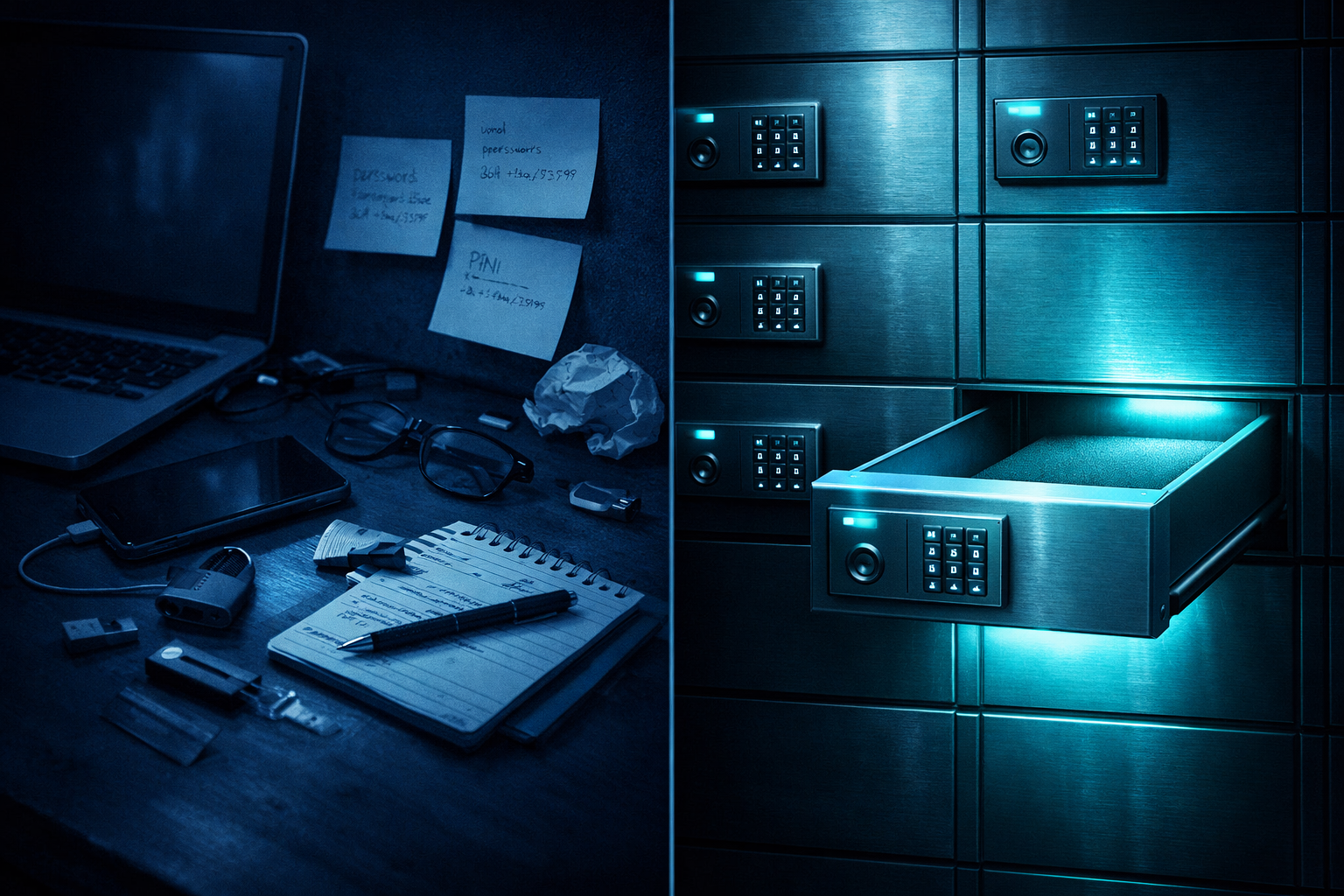
How home device accounts expose what they should protect.
Most homeowners today are doing the right thing: they use password managers, unique logins, and stronger security hygiene. The problem isn’t negligence—it’s scale. Over time, a single person may accumulate dozens, sometimes hundreds, of stored credentials across apps, devices, and services. When a home changes hands, sorting out which of those passwords belong to the house—and which belong to the person—becomes surprisingly difficult.
Smart homes amplify that burden. Whether a property has three Smart Device Fixtures or eighty-eight, the cognitive load of identifying, separating, and responsibly transitioning device-related accounts falls entirely on the seller. Even well-organized owners can miss something, not because they’re careless, but because the system was never designed for property transfer.
The safer model is not tighter personal security—it’s separation. When device documentation and identity are associated with a dedicated, property-bound reference instead of an individual’s personal accounts, continuity becomes manageable. A MyHOME ID provides that neutral home profile: a place where Smart Device Fixtures and their metadata can be documented without living inside a seller’s email, password manager, or personal digital life.
The distinction mirrors the difference between keeping valuables at home versus placing them in a safe-deposit box. One relies on individual memory and organization; the other removes friction by design. As connected homes become more common, separating personal digital identity from a home’s digital infrastructure will feel less like an extra step—and more like responsible stewardship at transfer.
When Smart Device Fixture information lives only inside personal accounts, transfer becomes a matter of memory, assumption, and good faith rather than proof.
Sellers are left to untangle which credentials belong to the home, which steps are required to relinquish access, and whether those steps were even effective—while buyers have no clear way to verify control. CleanSL8 documents Smart Device Fixtures at a specific moment in time, and anchoring that record within a MyHOME ID provides a property-bound reference that separates personal identity from home documentation. This documentation layer also underpins upcoming platform enhancements and business processes—such as the Neutral Access State (NAS)—designed to support more orderly, accountable smart-home transitions as properties change hands.
Learn how to prepare your next listing for a clean digital handoff by Booking A Zoom Call.